

Nearly one collision claim in four now ends with the car being declared a total loss. The rate reached a record 23.1 percent this year, up from 22.8 the year before and 22.1 the year before that, and the number that explains it best is a different one: more than seventy-two percent of those total-loss valuations are on vehicles seven years old or older. This is not mainly a story about crashes getting worse. It is a story about arithmetic on both sides of a fraction moving in the same unhelpful direction.
The fraction is repair cost divided by the car's actual cash value. Every state sets a rule for when an insurer stops repairing and starts writing a check: either a percentage threshold, from sixty percent in Oklahoma up to a hundred in Colorado and Texas with most near seventy to seventy-five, or a formula that totals the car when repair cost plus salvage value reaches its market value. In a seventy-five percent state, seventy-five hundred dollars of damage ends a ten thousand dollar car. Nothing about that rule changed this year. What changed is that repair estimates went up while the values of older used vehicles went down.
Sponsored by Golden Portfolio
One number flashed before every crash [and gold ran every time]
In 2000, one number hit an extreme high — and warned the dot-com crash was coming.
It was right.
In 1969, that same number spiked so high that Warren Buffett shut down his fund. He couldn't find anything worth buying.
It was right.
And in 1929, it flashed just before the worst market crash in American history.
Right again.
Every time this number reached an extreme, the same thing followed:
Stocks went nowhere for years… and gold ran for a decade.
They say history doesn't repeat. But it rhymes.
So what's the signal reading right now?
235% — the highest level in recorded history. Higher than 1929. Higher than 2000. It's so far outside the normal range the talking heads have simply decided to ignore it.
Big mistake.
Because every investor who ignored this signal in 1929… 1969… and 2000… paid for it.
And every investor who understood what it meant got positioned in gold before the rotation hit — and rode it for a decade.
Here's your choice:
You can trust that "this time is different"…
Or you can do what worked every other time this signal screamed — and get positioned in gold before the money rotates out of overpriced tech.
My name is Garrett Goggin, and I'm not like the other so-called gold analysts. It's why my portfolio is up as much as 1,200% in two years.
It's also why Porter Stansberry recently called me:
"THE most knowledgeable gold investor in the world."
The signal called it in 1929, 1969 and 2000. It's screaming louder today than at any point in history.
Go here to see how to position your portfolio in my four top gold picks.
Garrett Goggin, CFA, CMT
Lead Analyst and Founder, Golden Portfolio
Why the Estimate Keeps Growing
Two things are pushing the top of the fraction. The first is tariffs. A twenty-five percent duty on imported automobiles took effect in April of last year and the same rate on imported auto parts a month later, with medium and heavy trucks added in November. Roughly forty-four percent of original-equipment collision parts sold in the United States are made overseas, so the pass-through is direct: industry estimates put the added cost at around a hundred dollars on the parts line of an average repair order, with parts prices up more than six percent across two quarters. Sheet metal such as hoods and fenders has so far been largely outside the tariff, and domestic manufacturers have petitioned to bring it in.
The second is that cars became harder to fix. More than a quarter of repairable estimates now include recalibrating driver assistance sensors, and diagnostic scans appear on nearly nine in ten. A bumper is no longer a bumper; it is a mounting surface for radar that has to be aimed correctly afterward. Maintenance and repair costs have risen about forty-five percent in five years, roughly double general inflation.
The Mechanics of a Threshold Crossed From Both Sides
Now the bottom of the fraction. Used vehicle prices have been falling, down close to two percent over the past year, which sounds like good news and is the opposite for anyone holding an older car. Actual cash value is what the insurer owes, and it is also the denominator in the total-loss test. When the value of a twelve-year-old sedan drifts down while the cost of replacing its headlight assembly and recalibrating a sensor drifts up, the threshold gets crossed by damage that would have been repaired two years ago. The average vehicle on American roads is now 12.7 years old and heading for thirteen, and there are roughly twelve million fewer late-model vehicles in service than there were in 2020, so the fleet as a whole has aged into the zone where this happens easily.
What the Owner Actually Receives
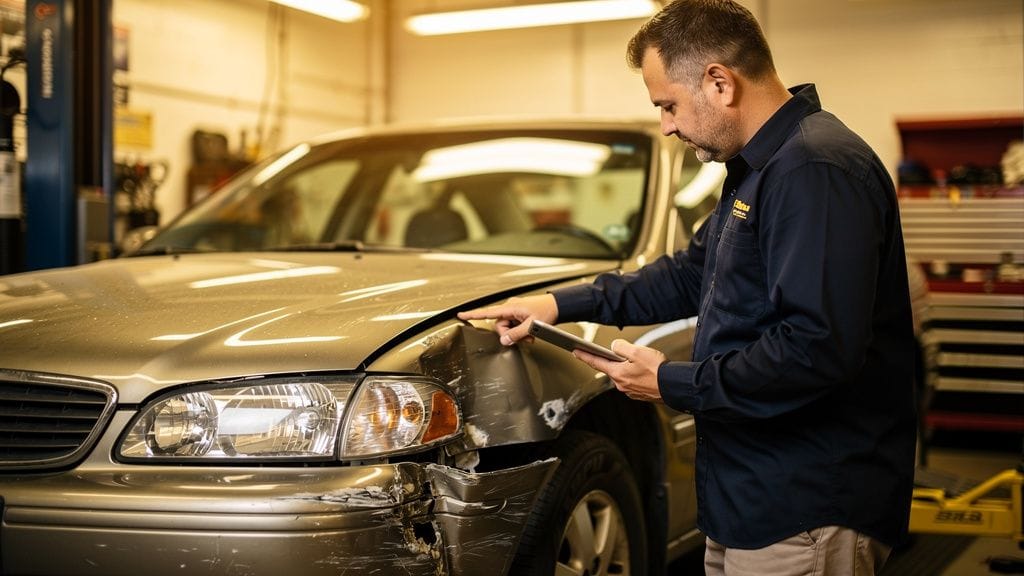
The consequence for the owner is not a repaired car and it is not a new one. It is a check for the depreciated market value of a vehicle they were driving perfectly well, arriving in a used car market where replacing it with something comparable generally costs more than the check. For a household that had deliberately kept an old car precisely because it was paid off and cheap to insure, a moderate parking lot collision can end that arrangement.
What the Premium Is Doing, and What to Check
Oddly, premiums are the calm part of this picture. The national average sits between roughly two thousand two hundred and two thousand six hundred dollars a year depending on the methodology, and this year's increase is small, around one to three percent after a much sharper run. The insurance component of the consumer price index has actually been falling for most of the past year. That gap between flat premiums and rising repair costs is unlikely to persist.
The more immediately useful point is the one that gets no attention at all. The total-loss decision is made by a ratio, not by how badly the car is damaged, so the older and cheaper a vehicle is, the less damage it takes to end it. Two things are worth knowing before a claim rather than during one: the state's threshold rule, since a seventy percent state and a hundred percent state produce different outcomes on the same dent, and what the insurer considers the vehicle's actual cash value, because that number is both the payout and the reason for it, and it is the one most worth disputing with evidence of condition and mileage.
Musk promises "universal high income." He's not wrong. (Sponsored by Freedom Financial Research)
The Pentagon said: Delete this (Sponsored by Freedom Financial Research)
Buy this stock tomorrow morning (Sponsored by Chaikin Analytics)
AI Pioneer Warns: Do NOT Buy SpaceX or Mag7 (Sponsored by TradeSmith)
Elon’s S-1 Master Plan Could Rewrite the Rules of AI (Sponsored by Altimetry)
Check Your Power Bill: New ‘AI Tax’ Rolling Out Nationwide (Sponsored by Altimetry)
The Crash That Destroys America (Sponsored by Stansberry Research)
Elon could save America by doing what!? (Sponsored by InvestorPlace Media)
Elon Musk: Buy Alert (Sponsored by InvestorPlace Media)
The AI Launch 57X Bigger than the SpaceX IPO (Sponsored by InvestorPlace Media)
Wall Street doesn’t want you to know about this AI stock (Sponsored by InvestorPlace Media)
FREE Ticker: Profit from rising bills? (Sponsored by Omnia Research)
Starting This July: Hundreds of trillions of dollars at stake (Sponsored by Brownstone Research)
Sam Altman and OpenAI set to trigger “AI IPO Tsunami” (Sponsored by Brownstone Research)
Two simple rules || Your first $1,000 (Sponsored by Omnia Research)
Act now before Midterm Boom begins on Nov. 3 (Sponsored by Brownstone Research)
Elon Musk's Empire Secretly Runs on This… (Sponsored by Omnia Research)
AI investors should get ready for a BIG surprise (Sponsored by Brownstone Research)
Elon Musk on His New Invention: “An Infinite Money Glitch.” (Sponsored by Brownstone Research)
New Pre-IPO Opportunity Backed by Elon: 8,000% Upside? (Sponsored by Brownstone Research)
While the whole world is watching Elon, the real money is moving somewhere else (Sponsored by Omnia Research)
The trader who called 2020 and 2022 crashes issues new prediction that will impact your money (Sponsored by Omnia Research)
The war we can’t afford to lose (Sponsored by Porter & Co.)
The Luddite Trap is coming. Warning. (Sponsored by Porter & Co.)
ALERT: Drop these 5 stocks! (Sponsored by Weiss Ratings)
Could Trump Explode Your Wealth? (Sponsored by Awesomely)
An Opportunity Is Brewing in the $110B Coffee Market (Sponsored by Green Coffee Company)
Meet the Wall Street Veterans Behind Colombia's #1 Coffee Producer (Sponsored by Green Coffee Company)
— John Stone