

David Egelhoff named his wife on his employer's life insurance and pension forms. They divorced in April 1994. He died two months later without changing anything, and Washington State had a law that automatically revoked a former spouse's beneficiary designation on divorce. His children from an earlier marriage sued for the 46,000 dollars. In 2001 the Supreme Court held that federal retirement law preempted the state statute, and the former wife kept the money.
The Court has said versions of this three times. In 2009 it held that a plan administrator must pay whoever is named on the form, even where a divorce decree purported to waive the benefit, and a former wife took roughly 400,000 dollars over the estate's objection. In 2013 it struck down a Virginia statute that tried to claw federal life insurance proceeds back from a former spouse, and a widow lost 124,558 dollars to her husband's ex-wife of ten years earlier. In every case the paperwork beat a divorce decree, a will and a state legislature.
Sponsored by Porter & Co.
No one has told you about it or prepared you for it…
But America’s money is being replaced.
A dollar reset on this scale has happened just once before in our 250-year history.
That was back in 1974, with a secret deal struck in a Saudi desert that quietly determined the financial fate of an entire generation of Americans.
It created extraordinary wealth for some, while casting millions more into relative poverty.
Now, 52 years later, it's happening again.
And I’d like to show you how to prepare for it, while there’s still time.
My name is Porter Stansberry.
I'm the founder of one of the largest independent financial research firms in the world. Over the last 30 years we've helped hundreds of thousands of Americans navigate almost every major economic cycle.
We've been on the forefront of every big financial story – from the collapse of Fannie Mae and Freddie Mac to the rise of Bitcoin, the COVID inflation surge, and the artificial intelligence revolution.
But today, I need to expose a story the likes of which we haven't seen in half a century.
And as you'll see, the aftershock of this event could reset not just your personal wealth, but the entire foundation of the U.S. dollar.
How you save, how you invest, how you protect everything you've built… it's all being reshaped by what Fortune calls "the biggest change to the world's relationship with the dollar" in a generation.
Yet almost nobody is prepared for it.
So if you've been watching the chaos of the past year unfold, struggling to make sense of it all – you're about to get the answers you've been searching for.
Everything from the government taking direct equity stakes in tiny mining companies… to Trump's obsession with Greenland… his strange deals with Elon Musk, Jeff Bezos, Sam Altman, and Mark Zuckerberg… the re-opening of shuttered nuclear plants… and a $12 billion stockpile of obscure metals most Americans have never heard of…
It's all deeply and inexorably connected to an inescapable fact no one has prepared you for:
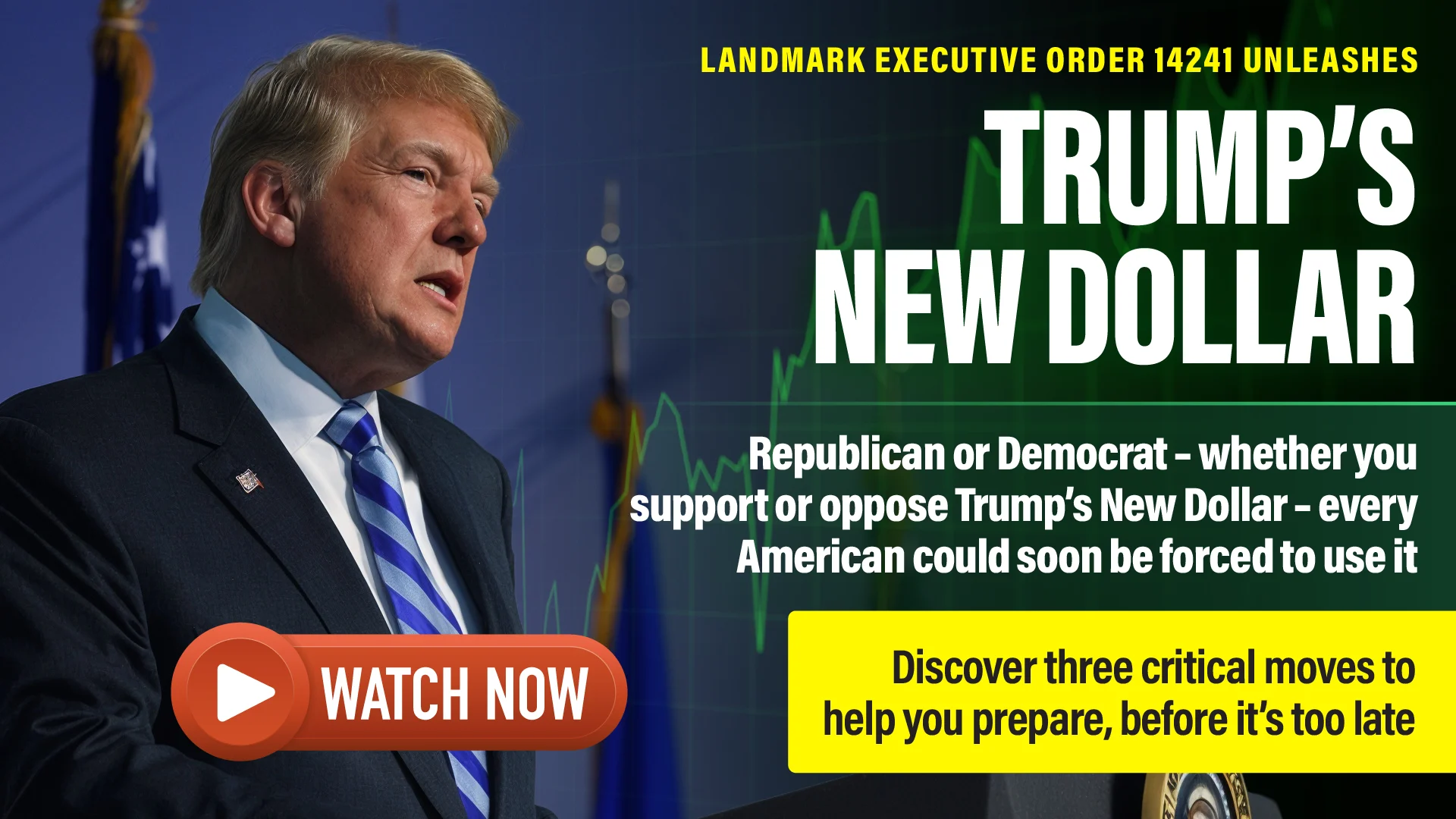
President Trump is replacing the dollar.
His shocking money reset has bypassed all conventional channels – enacted instead through a series of executive orders, bi-lateral deals, and a landmark treaty signed by 13 nations in December 2025 (barely reported in the press) called Pax Silica.
You need to know that the financial decisions you make in the face of Trump's New Dollar could dictate whether you're enriched, or quietly impoverished by the seismic shift already underway.
The stocks to buy. The assets to avoid. And the critical moves our research indicates you should make to ensure you and your family end up on the right side of this once-in-a-generation wealth divide…
It's all laid out here for you in my important new briefing.
Good investing,
Porter Stansberry
Why the Form Wins
The reason is simple enough to state and easy to forget. A will governs the probate estate, and the probate estate is only what is left after everything with a named beneficiary or a survivorship feature has already passed. Retirement accounts, life insurance, annuities, payable-on-death bank accounts and transfer-on-death brokerage registrations all move by contract at the moment of death. The will never touches them, so it cannot correct them.
Most households have more assets moving that way than through the will. One 2026 survey found just 36 percent of parents had designated beneficiaries on retirement accounts or life insurance at all, and two in five families had never discussed inheritance. A separate survey put the share of American adults with a will at 24 percent, down from 33 percent four years earlier.
The Mechanics of a Deed That Does Nothing Until It Does
Real estate has its own version, and it has spread quickly. A transfer-on-death deed, called a beneficiary deed in some states, is recorded during life, creates no present interest in the beneficiary, is revocable at any time, and passes the property automatically at death. Because it is revocable it is not a completed gift, so there is no gift tax consequence, and the beneficiary still gets a step-up in basis to the property's value at the date of death.
Thirty-two American jurisdictions now permit one. New York joined in 2024, Delaware in 2025, Maryland this month. Several large states still do not: Florida, Massachusetts, Pennsylvania, New Jersey and Connecticut among them, with Florida and Michigan using an older enhanced life estate deed instead.
Three details decide whether one works. It must be recorded before death, not merely signed. If the named beneficiary dies first the interest lapses and the property falls into probate. And it passes subject to every mortgage and lien on it.
Where It Stops Working
The uniform act itself contains the limit. Property transferred by a transfer-on-death deed remains liable to the probate estate for allowed claims to the extent the estate cannot pay them. Creditors are not defeated, only inconvenienced.
Medicaid estate recovery is the sharper version. Federal law requires states to recover long-term care costs from the estate of anyone who received benefits at 55 or older, and lets each state define estate narrowly or broadly. In roughly half the states the definition reaches only probate property, which is why a transfer-on-death deed removes the house from reach. In the other half it reaches assets conveyed through joint tenancy, survivorship, life estates, living trusts or, in Ohio's statutory phrasing, any other arrangement. Which half you live in decides whether the deed did what you intended.
The Older Habit That Costs More
The instinct many families reach for first, adding an adult child to the deed as a joint owner with right of survivorship, avoids probate and creates three problems the deed does not. It is a completed gift, measured against the annual exclusion. It is an asset transfer that starts the five-year look-back for Medicaid eligibility. And it costs basis: on a jointly held property only the deceased owner's fractional share steps up, so a child who was added years earlier inherits the original cost on their own half and a large capital gain with it.
The document people spend money on is the will, and the documents that actually move the money are the ones filled in years ago at a bank counter or on a form at a new job. An afternoon settles it. List every account and policy, request the current beneficiary designation for each in writing rather than trusting memory, and check that each one names a living person and a contingent beneficiary behind them. Then ask whether your state defines the Medicaid estate narrowly or broadly, because that single answer determines whether a transfer-on-death deed protects the house or merely relocates it.

The AI Code Review Agent reviews more than 10,000 pull requests every week across customer teams. (Sponsored by Bito)
Grounded coding with AI Architect achieves 39% higher task success than coding agents without system context. (Sponsored by Bito)
America's solution to universal basic income already exists. (Sponsored by Freedom Financial Research)
Elon Musk on His New Invention: “An Infinite Money Glitch.” (Sponsored by Brownstone Research)
Buffett’s “Green New Deal” (trigger warning!) (Sponsored by Porter & Co.)
My next Netflix-sized prediction (Sponsored by Stansberry Research)
Where the rich grow their portfolios twice as fast (Sponsored by Omnia Research)
Jeff Brown: “If I Could Only Buy One AI Stock, This Would Be It” (Sponsored by Brownstone Research)
DISCLAIMER
The content in this email does not constitute an offer or solicitation to buy or sell any financial instrument. All commentary is general in nature and is not directed at any individual investor.
— John Stone